Country pavilion
complete guide
Multi-company national showcases at international expos — how they work, who organises them, how they differ from corporate stands, and what makes them succeed.
Built for brands you may already know.
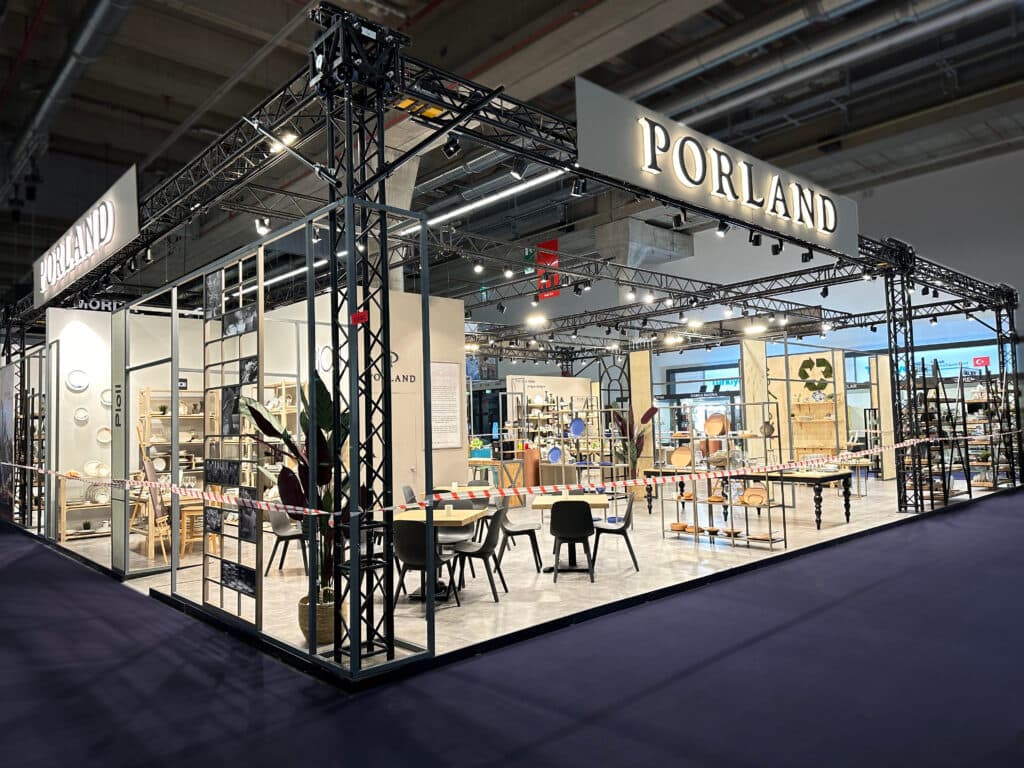
Porland
Ambiente Frankfurt 2024 · 365 m²

Pioli
EquipHotel Paris

Youth House
COP29 Baku · 1200 m²

Baykar
Marrakech Air Show · 250 m²
Design: Istanbul Studio · Manufacture: Kağıthane HQ · Single senior project manager
Since 2014 · Operating in 31 countries · 5 global offices
A pavilion is more than a large stand — it's a national showcase.
A country pavilion is a multi-company exhibition space at an international trade fair that represents an entire nation's industry under one coordinated identity. Where a corporate exhibition stand promotes one company, a pavilion promotes a country — its exporters, its institutions, its cultural credibility in a sector. Companies inside the pavilion benefit from shared infrastructure, the gravitas of national branding, and often public funding that subsidises participation.
Pavilions exist at every scale. A small sector pavilion at a niche fair might feature 8 companies in 100 sqm. A flagship national pavilion at GITEX, Anuga, or IDEX can host 60+ companies across 1,500 sqm. World Expo pavilions like those at Dubai 2020 or Osaka 2025 are entire architectural projects representing a country for six months.
Pavilion questions answered.
What is a country pavilion?
A country pavilion is a large multi-company exhibition space at an international trade fair, designed to represent a single nation's industry collectively. Companies from that country exhibit under a unified national identity — shared design language, national branding (flag, government endorsement), and often a central feature area with cultural or institutional content. Pavilions range from 100 sqm at niche trade fairs to 6,000+ sqm at World Expos.
Who organises country pavilions?
Most country pavilions are organised by one of three types of entity: (1) a government export-promotion agency (such as Turquality, Germany Trade & Invest, JETRO in Japan, KOTRA in Korea), (2) an industry association representing a specific sector (defence, food, automotive), or (3) a chamber of commerce. The organising entity selects participating companies, manages registration with the fair, contracts the design and build, and coordinates national branding.
How is a country pavilion different from a corporate exhibition stand?
Four key differences. (1) Scale — pavilions are typically 5–50× larger than corporate stands. (2) Branding — national identity dominates over individual company logos. (3) Governance — multiple stakeholders (government, association, participating companies) approve design decisions. (4) Procurement — most pavilions are awarded through public tender with specific compliance requirements (state aid rules, transparency obligations). The design challenge is creating coherence across multiple companies under one roof.
How much does a country pavilion cost?
Costs vary enormously by scale. A 100 sqm sector-specific pavilion at a regional trade fair starts around €40,000–€80,000. A 500 sqm pavilion at a major international fair (Hannover Messe, GITEX, Anuga) typically runs €200,000–€500,000. World Expo pavilions can reach €5M–€50M+ for the largest national presences. Costs include design, build, freight, on-site staffing, hospitality elements, and sometimes a permanent cultural programme alongside the trade exhibition.
What is the difference between a World Expo pavilion and a trade fair pavilion?
World Expo pavilions (Dubai 2020, Osaka 2025) are permanent or semi-permanent national showcases lasting 6 months, focused on cultural diplomacy and national branding for the general public. They are architectural projects with significant cultural content. Trade fair pavilions (Anuga, GITEX, IDEX) are temporary structures lasting 3–7 days, focused on B2B business outcomes for participating exporters. World Expo budgets are typically 10–100× larger than trade fair pavilions.
Who selects the pavilion builder?
Most government-organised pavilions select builders through a public tender process. The tender specifies the design brief, budget cap, technical requirements, and evaluation criteria. Builders submit proposals with 3D concepts, references, and pricing. Evaluation typically weights design quality (40%), price (30%), past pavilion experience (20%), and local presence in the host country (10%). Decisions usually take 4–8 weeks. Pre-qualification is increasingly common — builders must demonstrate prior pavilion delivery before participating.
What makes a country pavilion successful?
Five success factors. (1) Coherent design that integrates participating companies without flattening their identities. (2) Strong national hero element (cultural piece, central feature, signature architecture) that draws visitors. (3) Hospitality space for VIP meetings — often where most business deals are closed. (4) Cultural programme integrated with the trade activity (cooking demos for food pavilions, defence equipment displays for IDEX-style fairs). (5) Pre-event marketing coordinated with embassies, chambers, and participating companies to drive visitor traffic.
What experience do we have with country pavilions?
Evreka Stand has delivered pavilions at COP29 Baku (multiple national hosts, 1,200+ sqm combined), SAHA EXPO (UAE National Pavilion, 450 sqm), IDEF (China Defence Pavilion, 420 sqm with 35 modular stands), and other major international expos. Our team coordinates the multi-stakeholder process — government agency, exporters association, individual companies — under one project management structure. We hold pre-qualification status with several national export agencies.
What are the best country pavilion stands in Europe?
European country pavilion programmes that consistently deliver high-quality stands include: Germany at GITEX (Germany Trade & Invest, GTAI), Turkey at IDEX (Savunma Sanayii Başkanlığı SSB pavilion), France at Eurosatory (GICAT-organised), Italy at IDEF (ICE Agency), Japan at Anuga (JETRO), South Korea at MWC Barcelona (KOTRA). For European exhibitors, the canonical venues are Hannover Messe (industrial), Anuga Köln (food), EuroShop Düsseldorf (retail technology), Eurosatory Paris (defence), CPhI Frankfurt (pharma), and ITB Berlin (travel). Country pavilion at any of these typically runs 200-1,500 m² with €150,000-€800,000 budget depending on scale.
How does country pavilion design and build work in Dubai/UAE?
Dubai and Abu Dhabi country pavilions are concentrated at three main venues: Dubai World Trade Centre (Big 5 Dubai, Gulfood, GITEX), DWTC al-Mamzar exhibition halls, and ADNEC in Abu Dhabi (IDEX, NAVDEX, ADIPEC). UAE country pavilion typical workflow: (1) export-promotion agency or sector association tenders for pavilion design and build 6-9 months pre-show, (2) winning contractor delivers concept design + 3D, (3) tender approves and signs contract, (4) production runs at contractor home country or local UAE atelier, (5) installation 5-7 days pre-show with UAE Federal Customs Authority clearance, (6) post-show dismantle and storage. UAE pavilions tend toward premium finishes (lacquered wood, marble accents, brushed brass) reflecting regional design preferences. Budget €250-€650/m² for mid-tier, €600-€1,200/m² for OEM/government flagship pavilions.
How does a Specialised Expo pavilion work — Belgrade 2027?
At a Specialised Expo such as Expo 2027 Belgrade (15 May–15 August 2027) the organiser builds the structure and each country fits out a modular shell of 324, 648 or 972 m² with a 10 m height limit; the shell is handed over on 15 October 2026 and the interior must be complete by 31 March 2027. Participants must use contractors licensed in Serbia or pair a foreign contractor with a locally licensed Architect of Record. Our Expo 2027 Belgrade page carries the published dates, the Türkiye pavilion facts and the fit-out scope.
Who are the leading country pavilion exhibition stand builders?
The country pavilion stand-builder market has three tiers. Tier 1 — global multi-vertical builders with annual revenue €50M+ and 200+ staff (Messe Frankfurt-affiliated firms, ExpoMobilia, Pico Group, Production Bureau). Tier 2 — regional specialists with deep relationships at specific venues (Evreka Stand for Turkish defence + COP + UAE; ATC Pivot for German export pavilions; Salon Display Service for French pavilions). Tier 3 — local builders without international footprint. The choice depends on (a) where the pavilion is located, (b) the budget, (c) whether the organising agency has pre-qualification requirements. Most export-promotion agencies maintain a panel of 3-5 pre-qualified builders rather than open tender every event.
What's the typical timeline for country pavilion design and build?
Standard timeline from concept to fair-day opening is 5-7 months. Month 1: brief + multi-stakeholder kick-off (government agency, association, participating companies). Month 2: design competition or single-contractor concept brief, 3D concept delivery, 2-3 revision rounds. Month 3: technical drawings, fair venue submissions, government compliance sign-off. Months 4-5: production. Month 6: freight + on-site installation (5-7 days). Fair opens. Plan to start brief at least 6 months pre-show; 9-12 months for World Expo or pavilions over 500 m². Expedited 3-month delivery is technically possible for 150-300 m² pavilions but typically 25-40% cost premium and material constraints.
What are country pavilion design best practices?
Six rules from delivered work: (1) National identity at the entrance — the visitor must know within 3 seconds which country this represents (flag, country name, signature architectural element). (2) Brand of participating companies inside, not outside — country first, companies second. (3) Hospitality space at least 25-30% of total area — this is where business closes. (4) Central feature / cultural element that draws visitors who weren't planning to enter — food sample station for food pavilion, demo platform for defence, immersive video for tourism. (5) Clear visitor flow from entrance to exit, avoiding dead-ends where conversations stall. (6) Re-usable modular infrastructure when the same pavilion repeats annually — Evreka Stand routinely designs pavilions where 60-70% of components return for the next edition with refreshed graphic skins.
How does a country pavilion fit into a national export strategy?
Country pavilions are one tool within an export-promotion framework typically owned by a government ministry (Trade, Foreign Affairs, Industry, or a dedicated agency). The framework includes: market research grants, trade-mission funding, country-pavilion budgets, embassy commercial-officer support, trade-credit / export-credit insurance, post-show lead follow-up. Country pavilion participation alone rarely generates immediate large contracts; it generates qualified leads that the agency's commercial network then nurtures over 12-36 months. For exporters, the implication is: a single pavilion event must connect to a longer commercial pipeline. Top-performing agencies (KOTRA, JETRO, Turquality) have pre-event matchmaking, on-event meeting scheduling, and post-event follow-up structured into the pavilion budget.
Can Evreka Stand build country pavilions in Europe and Dubai?
Yes. We have delivered country pavilions across both Europe (COP29 Baku, IDEF Türkiye-hosted international pavilions) and the GCC (UAE National Pavilion at SAHA EXPO 450 m², ongoing UAE projects). Europe logistics: TIR road freight from Istanbul covers Germany, France, Italy, Netherlands, Belgium, Spain in 4-7 days. UAE: sealed-container sea freight Istanbul → Jebel Ali in 10-14 days, or local-build option via Dubai/Abu Dhabi atelier partner. Pre-qualification with several Turkish + GCC export-promotion agencies allows direct tender participation. Contact us for a brief evaluation; we typically respond within 24 hours with budget range + initial timeline.