Sustainable exhibition stands
in Europe
How to reduce exhibition stand waste by up to 80%, document carbon impact for ESG reporting, and choose materials that align with your sustainability commitments.
Built for brands you may already know.
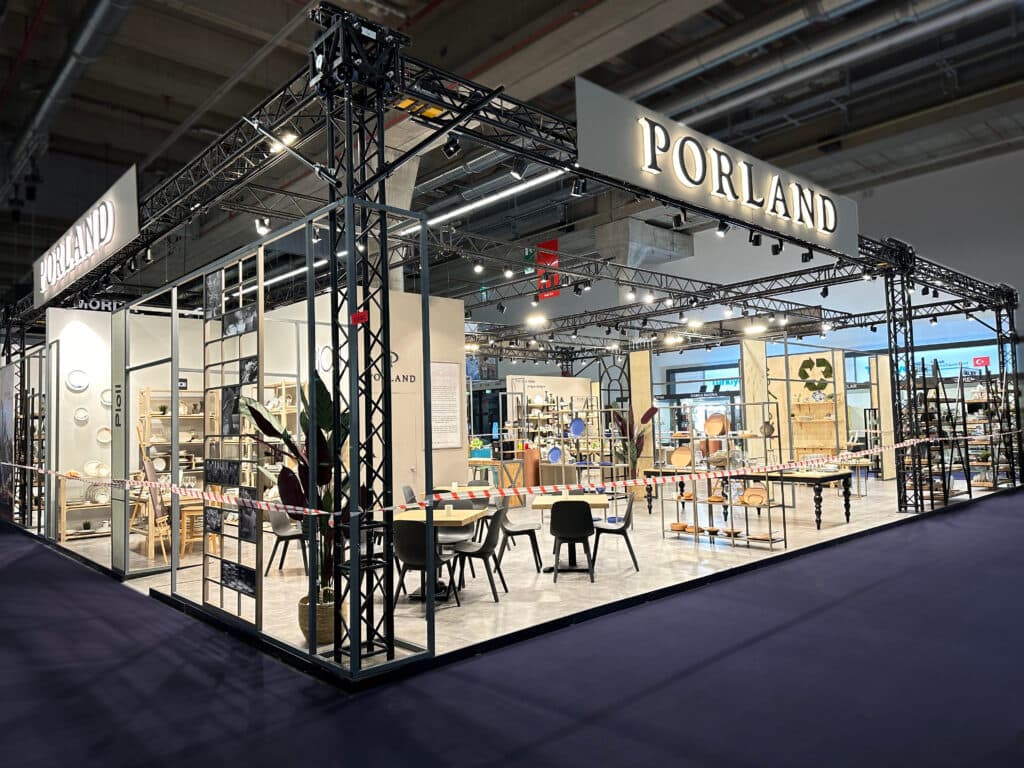
Porland
Ambiente Frankfurt 2024 · 365 m²

Pioli
EquipHotel Paris

Youth House
COP29 Baku · 1200 m²

Baykar
Marrakech Air Show · 250 m²
Design: Istanbul Studio · Manufacture: Kağıthane HQ · Single senior project manager
Since 2014 · Operating in 31 countries · 5 global offices
The exhibition industry generates millions of tonnes of waste each year.
Most exhibition stands are built, used for 3–5 days, and discarded. A typical 50 sqm custom stand generates 800–1,500 kg of waste per event — primarily MDF panels, vinyl graphics, disposable carpet, and packaging materials. Multiply that across 32,000 trade fairs annually and the global footprint becomes one of the largest in the events industry.
Reducing this impact is now non-negotiable for European exhibitors subject to CSRD reporting, for global brands with science-based targets, and increasingly for any company whose customers care about sustainability. The good news: meaningful reductions are practical and don't require sacrificing design quality.
One thing to be clear about before you brief anyone: "sustainable" is not a regulated word in this industry. Sustainable stands in Europe are judged by three separate things, and a supplier can be strong on one while ignoring the other two — the materials themselves (FSC timber, recycled aluminium, solvent-free print), what happens to the structure after the show (reuse, storage, or landfill), and whether any of it is measured and reported back to you. Ask which of the three a quote actually covers. If a builder cannot tell you where your stand goes on the Monday after the show, the first two claims do not mean much.
Six practices that move the needle.
Modular reusable systems
Aluminium framing reused 5–10 times. Per-event waste reduced 70–80%.
FSC-certified timber
Forest-stewardship-certified MDF and panels. Required for most ESG reports.
PVC-free graphics
Paper, fabric, biodegradable polymer substrates instead of vinyl flex.
LED energy efficiency
Low-wattage lighting and motion-triggered fixtures cut power draw 40–60%.
Regional production
Manufacturing in the same continent as the event slashes freight emissions.
Post-event recycling
Pre-agreed disposal protocol with the venue ensures materials are recycled, not landfilled.
Sustainability questions answered.
How is an exhibition stand made more sustainable?
Six concrete practices: (1) use modular systems that can be reused 5–10 times instead of single-use custom builds, (2) specify FSC-certified timber and recycled aluminium for structural elements, (3) print graphics on PVC-free substrates (paper, fabric, biodegradable polymers), (4) source LED lighting with low energy draw, (5) use a builder with regional production hubs to reduce freight emissions, (6) plan a disposal protocol with the venue for recycling or donation of unused materials after the event.
What is the environmental impact of a typical exhibition stand?
An average custom exhibition stand of 50 sqm generates between 800 and 1,500 kg of waste from a single use — primarily MDF, plastic-based graphics, and disposable carpet. International freight adds roughly 1.5–3 tonnes of CO2 depending on origin. Multiply this across 32,000+ trade fairs per year and the industry's footprint is substantial. Modular stands reused four times reduce per-event waste by 70–80% and freight emissions by 50–60% if shipped from a regional warehouse.
What is FSC-certified timber and why does it matter?
FSC (Forest Stewardship Council) certification means timber comes from forests managed to environmental, social, and economic standards. For exhibition stands this matters because MDF and timber wall panels are major structural components — choosing FSC reduces deforestation pressure. Most European exhibitors with ESG reporting require FSC for all wood-based materials. The price premium is typically 5–10%, often offset by ESG credit value.
Can I rent an exhibition stand instead of building one?
Yes — rental is the most sustainable option for occasional exhibitors. A rented modular stand uses inventory that is already in circulation across dozens of events. Your event-specific elements are limited to printed graphics and any custom feature pieces. Rental typically costs 30–50% less than buying a custom stand and produces a fraction of the waste. The trade-off is reduced design uniqueness; rental systems work within their standardised configurations.
How does freight affect stand sustainability?
Freight is often the largest carbon component of an exhibition stand project. Shipping a 50 sqm stand from Asia to Europe by sea generates 2–4 tonnes of CO2; by air, 8–15 tonnes. Producing locally in the target region cuts this by 70–90%. This is why international stand builders with regional production hubs (in our case Istanbul, Rotterdam, Cary NC, Doha, Baku) deliver lower freight emissions than centralised manufacturers shipping worldwide.
What sustainability documentation should I request from a stand builder?
Ask for: (1) a materials breakdown listing each component, its origin, and recyclability, (2) FSC certificates for any timber used, (3) graphic substrate specifications confirming PVC-free options, (4) freight route and estimated CO2, (5) post-event disposal plan (warehouse return, recycling partner, or donation), (6) a stand sustainability scorecard if the builder publishes one. This documentation feeds directly into your ESG reporting and helps demonstrate compliance with frameworks like GRI, CDP, or CSRD.
Are LED screens more sustainable than printed graphics?
For one-off use, printed graphics have lower lifecycle impact than LED — manufacturing and disposing of electronic displays is energy-intensive. But for exhibitors who reuse content across multiple events, LED screens become more sustainable because the same display serves dozens of events while graphics must be reprinted each time. Decision rule: reuse 5+ events → LED is better; single event → printed fabric or paper graphics are better.
How does sustainability affect stand costs?
Sustainable builds are 5–15% more expensive upfront for materials. The total cost over multiple events is typically LOWER because modular reuse reduces per-event cost dramatically. Many exhibitors find sustainability pays for itself: a modular stand reused four times costs 40–50% less per event than four separate custom builds. ESG-conscious clients also report measurable value in brand reputation and contract wins with sustainability-conscious customers.