Trade show
ROI measurement
Formulas, KPIs, and benchmarks for measuring the return on your exhibition investment. From cost per qualified lead to 12-month revenue attribution.
Built for brands you may already know.
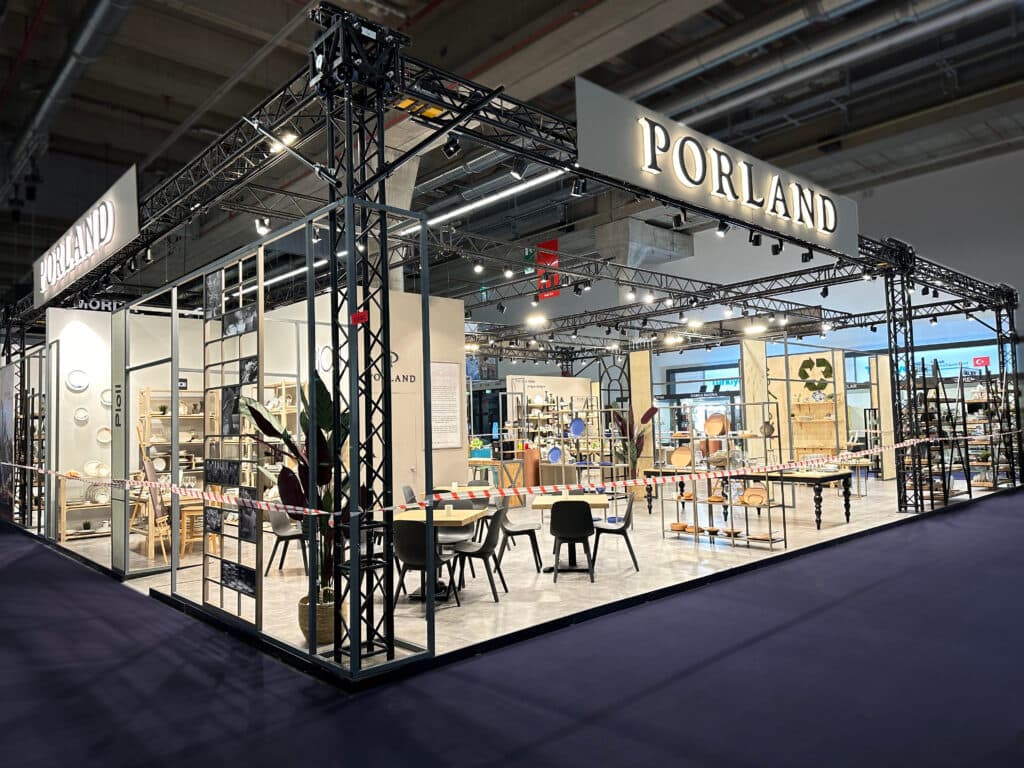
Porland
Ambiente Frankfurt 2024 · 365 m²

Pioli
EquipHotel Paris

Youth House
COP29 Baku · 1200 m²

Baykar
Marrakech Air Show · 250 m²
Design: Istanbul Studio · Manufacture: Kağıthane HQ · Single senior project manager
Since 2014 · Operating in 31 countries · 5 global offices
What gets measured gets funded.
Trade show budgets are among the largest discretionary marketing spends in B2B. They're also among the most difficult to defend internally because the impact spans months, not days. Companies that measure exhibition ROI rigorously protect their event budgets through downturns; companies that don't often see exhibition spend cut first when finance reviews discretionary marketing.
This guide covers the three core ROI formulas used in B2B exhibition measurement, the eight KPIs you should track, and sector benchmarks for what good performance looks like.
ROI questions answered.
How do you measure exhibition stand ROI?
Three formulas are used in B2B exhibition measurement. (1) Financial ROI = (revenue attributed to event leads − total event cost) ÷ total event cost. (2) Cost per qualified lead = total event cost ÷ number of qualified leads collected. (3) Cost per meeting = total event cost ÷ number of booked meetings held on the stand. Most B2B exhibitors track all three because each tells a different story — financial ROI requires a long attribution window (often 12–24 months), while cost per lead and per meeting are immediately measurable.
What KPIs should I track at an exhibition?
Eight core KPIs. (1) Total leads captured. (2) Qualified leads (passed a defined scoring threshold). (3) Meetings held on stand. (4) Meetings converted to second meetings post-event. (5) Pipeline value created within 90 days. (6) Closed business attributed to event leads within 12 months. (7) Cost per qualified lead. (8) Visitor-to-lead conversion rate (leads ÷ unique stand visitors). For sustainability-conscious exhibitors, add: per-event waste in kg, freight CO2, and percentage of reusable materials.
What is a good cost per qualified lead at a trade show?
Benchmarks by sector for B2B trade shows: industrial manufacturing €100–€300 per qualified lead; technology and SaaS €150–€450; defence and aerospace €500–€1,500 (low volume, high deal size); food and HoReCa €50–€200; medical devices €200–€600. Compare against your alternative channels — if Google Ads cost per qualified lead is €150 and trade shows are €120, the show is cost-competitive before accounting for relationship and brand value that ads can't replicate.
How long should I wait before measuring trade show ROI?
B2B sales cycles are long, so attribution windows matter. Use a phased approach: 30 days for lead quality assessment and immediate pipeline; 90 days for first-stage conversion (proposals submitted, second meetings booked); 12 months for closed-won revenue attribution; 24 months for full deal value including expansion and renewal. Trying to measure ROI 30 days post-event in a sector with 6–18 month sales cycles produces misleadingly low numbers.
What stand size delivers best ROI?
Counterintuitively, mid-sized stands (40–80 sqm) often deliver better ROI than very large stands. Below 30 sqm visitors don't stop — you lack visual presence. Above 100 sqm cost grows faster than incremental lead volume. The sweet spot is large enough to attract attention and host 2–3 meetings simultaneously, small enough to keep the budget proportionate. Test by tracking cost per qualified lead across event sizes — most exhibitors find diminishing returns above 80 sqm unless the event is strategic.
How do I qualify leads at an exhibition?
Use a four-question lead scoring framework that staff complete in under 60 seconds per conversation: (1) Is the visitor a decision-maker or influencer at their company? (2) Is their company in our target customer profile? (3) Do they have an identified need we can address? (4) Do they have a defined timeline (next 6 months, 6–18 months, exploratory)? Each yes = 1 point. Score 3+ = qualified lead, prioritise within 48 hours. Score 2 = nurture. Score 0–1 = newsletter only.
Does stand design quality affect ROI?
Yes, measurably. Studies by CEIR (Center for Exhibition Industry Research) consistently show that well-designed stands generate 25–40% more visitor stops, longer visit duration, and higher lead-to-meeting conversion than basic shell-scheme builds at the same shows. Design quality affects four things: (1) likelihood of visitor stopping, (2) time spent on stand, (3) perception of company credibility, (4) recall after the event. Investing in design is rarely the cost-saving point — it's usually the leverage point for the rest of the budget.
Should I measure brand impact separately from leads?
Yes — brand metrics complement lead metrics for a full picture. Track: (1) social media impressions and engagement from event-tagged content, (2) press mentions during and after the event, (3) website traffic spike during event week, (4) branded search volume increase, (5) sales team feedback on customer awareness of your brand. For large exhibitors with budget allocated to brand-building (not just lead generation), these metrics often justify more of the spend than direct lead ROI.