What is an
exhibition stand?
A complete reference on exhibition stands — definition, types, components, costs, and the full design-to-installation process.
Built for brands you may already know.
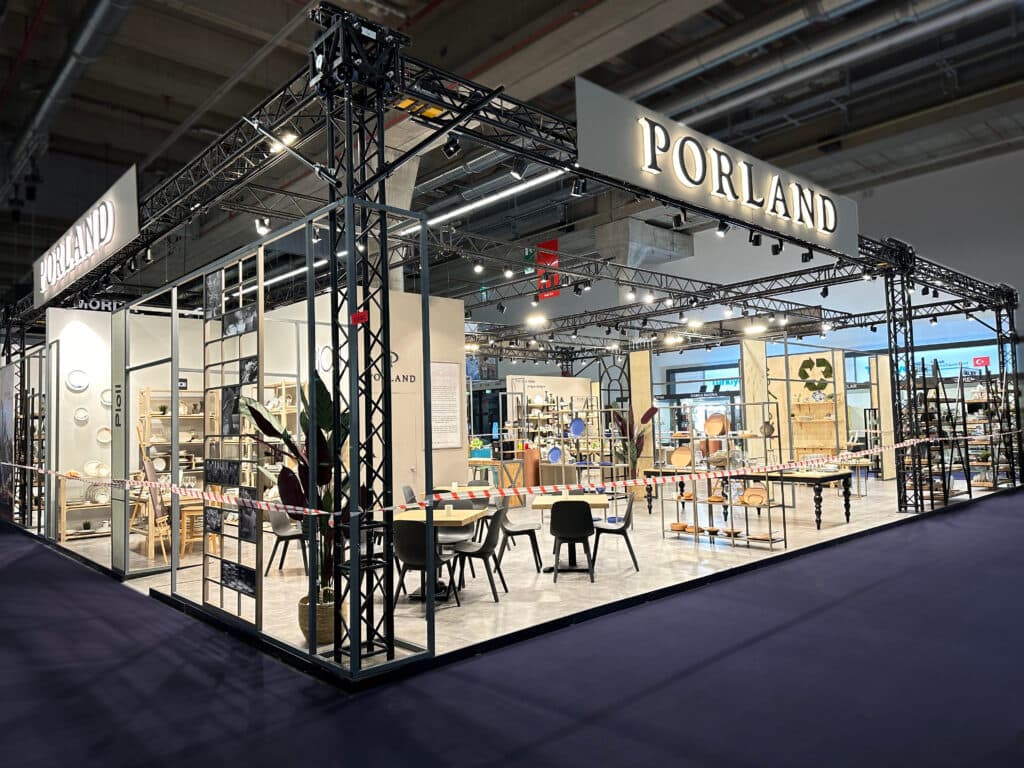
Porland
Ambiente Frankfurt 2024 · 365 m²

Pioli
EquipHotel Paris

Youth House
COP29 Baku · 1200 m²

Baykar
Marrakech Air Show · 250 m²
Design: Istanbul Studio · Manufacture: Kağıthane HQ · Single senior project manager
Since 2014 · Operating in 31 countries · 5 global offices
An exhibition stand is a temporary branded structure built at a trade fair.
An exhibition stand — known as a trade show booth in North America — is a purpose-built, temporary structure inside a trade fair, expo, or convention hall. Companies use stands to showcase products, host meetings, generate leads, and reinforce brand identity in front of a concentrated B2B audience. The stand is designed, manufactured, transported to the venue, installed before the event, and dismantled afterwards. Most stands have a working life of 3–5 days, the duration of the fair.
The global exhibition industry hosts more than 32,000 trade fairs each year, attended by over 300 million visitors. For B2B companies in sectors such as defence, food & beverage, energy, technology, and automotive, a strong stand at the right show is one of the most cost-efficient ways to meet decision-makers face to face.
The five main types of exhibition stand.
Custom (Bespoke)
Fully designed and built from scratch for one event. Maximum brand control and uniqueness. Highest cost and lead time.
Best for: Large brands, premium positioning, hero events
Modular
Reusable aluminium framing system with custom graphics. Reconfigurable for different stand sizes across events.
Best for: Multi-event annual calendars, mid-size budgets, cost efficiency
Shell Scheme
Pre-built basic booth provided by the organiser. Customised only with graphics, furniture, and lighting.
Best for: First-time exhibitors, small budgets, single-event participation
Double-Decker
Two-storey structure with meeting rooms or lounges above the show floor. Visual dominance and private space.
Best for: Large exhibitors at major shows requiring private meeting areas
Country Pavilion
Large multi-company stand representing a nation's industry. Coordinated branding under a national identity.
Best for: Trade associations, export agencies, government-led delegations
What an exhibition stand is made of.
Structural shell
Aluminium framing, MDF panels, or timber walls forming the perimeter and any internal divisions
Graphics
Large-format printed walls, illuminated lightboxes, vinyl floor decals, digital screens
Lighting
Spotlights, LED strips, backlit lightboxes, hanging signs (when permitted)
Meeting area
Private or semi-private space with table and chairs for client conversations
Demo zone
Open area for product demonstrations, often with interactive screens
Reception / welcome desk
Branded counter at the entry, staffed for greeting and lead capture
Storage / back office
Hidden closet for stock, coats, marketing collateral, and personal items
Flooring
Raised platform with carpet, vinyl, or wood-effect surface for visual lift
AV equipment
Screens, sound systems, video walls, demo tablets — rented or built into the stand
From brief to dismantling — the full process.
Brief & objectives (week 0)
Exhibitor defines budget, target audience, stand size, key products to feature, and event date. The builder asks about KPIs (leads, meetings, brand exposure) to inform design priorities.
Concept design (weeks 1–3)
Designers produce 2–3 visual concepts in 3D rendering. Floor plans, sightlines, and brand consistency are reviewed with the exhibitor.
Technical drawings (weeks 3–5)
Approved design is converted into manufacturing drawings. Materials specified. Floor plan signed off with the venue organiser.
Production (weeks 5–10)
Structural elements fabricated. Graphics printed. Furniture sourced. Pre-build at the workshop verifies the stand assembles correctly.
Freight (weeks 10–11)
Stand packed and shipped to the venue. International freight, customs clearance, and on-time delivery to the show floor.
Installation (2–4 days before opening)
On-site crew assembles the stand at the exhibitor's allocated floor space. Electricals tested. Final cleaning and graphic check before show open.
Show days (3–5 days)
Stand staff operate the booth. Build team available on standby for repairs and adjustments.
Dismantling (1–2 days after closing)
Stand disassembled and removed. Reusable elements returned to the warehouse. Disposable elements recycled or disposed of according to venue rules.
Exhibition stand questions, answered.
What is an exhibition stand?
An exhibition stand (also called a trade show booth in North America) is a temporary, custom-designed branded space built within a trade fair, expo, or convention. Companies use exhibition stands to present products, demonstrate services, generate leads, host meetings, and reinforce brand identity with a target B2B audience. A stand typically combines structural walls, branded graphics, lighting, furniture, demo equipment, and meeting areas — all installed before the event and removed after it ends.
What is the difference between an exhibition stand and a trade show booth?
The two terms describe the same physical object — a temporary branded structure at a trade fair. 'Exhibition stand' is the standard term in the UK, Europe, the Middle East, and most of the world. 'Trade show booth' is the standard term in the United States and Canada. The construction methods, materials, and design principles are very similar globally, though US shows tend to use square-foot pricing and have specific union-labour and drayage rules that differ from European practice.
What are the main types of exhibition stands?
There are five main types. Custom (or bespoke) stands are fully designed from scratch for one specific event and brand — the most flexible and most expensive. Modular stands use a reusable aluminium framing system with interchangeable graphics — cost-effective when reused across multiple events. Shell-scheme stands are basic pre-built booths supplied by the organiser, customised mainly through graphics. Double-decker stands have two storeys, used by large exhibitors needing meeting space above the show floor. Country pavilions are large multi-company stands built to represent a nation's industry at international expos.
What components make up an exhibition stand?
A typical exhibition stand combines several elements. The structural shell — walls, beams, and ceiling elements — is usually built from aluminium framing, MDF, or timber. Graphics include large-format printed walls, illuminated lightboxes, and digital screens. Functional zones inside the stand include a product display area, an interactive demo station, a meeting room or lounge with seating, a storage closet (back office), and a reception or welcome desk. Lighting, AV equipment, flooring (raised platform, carpet, or vinyl), and furniture complete the build.
Why do companies invest in custom exhibition stands?
A trade fair is one of the few B2B environments where prospects come willingly with budget and intent to evaluate suppliers. A purpose-built stand allows a company to control the first impression, demonstrate scale and seriousness, host private meetings during the event, and stand out visually from competitors with off-the-shelf booths. The return is measured in qualified leads, signed contracts, brand recall in the target market, and meetings that would otherwise take months to arrange individually.
How long does it take to design and build an exhibition stand?
From brief to installation, a custom exhibition stand typically takes 8 to 16 weeks. The first 2–4 weeks cover briefing, concept design, and 3D visualisation. The next 4–8 weeks are detailed technical drawings, materials sourcing, and manufacturing. Final 1–2 weeks involve freight, on-site installation (usually 2–4 days at the venue before the show opens), and dismantling. Rush projects are possible but typically cost 20–40% more.
What does an exhibition stand cost?
Costs vary widely by region, design complexity, and size. A custom-built stand in Europe typically runs €150–€400 per square metre for the design and build (excluding floor space rental from the organiser). A modular stand can be 30–50% cheaper because the structural frame is reused across events. In the USA, expect $140–$400 per square foot. Large country pavilions and double-deck stands above 200 sqm easily exceed €100,000–€300,000+ as a turnkey package. See our exhibition stand cost guide for detailed regional pricing.
What is a turnkey exhibition stand?
A turnkey exhibition stand is a single-vendor service in which one company handles every step — design, manufacturing, freight, installation at the venue, and dismantling after the show. The exhibitor receives a finished stand and walks away with no operational responsibility. This contrasts with à-la-carte models where the exhibitor coordinates multiple suppliers (designer, builder, freight forwarder, installer) themselves. Turnkey is the standard for international exhibitors who travel to foreign markets and cannot manage local logistics directly.
Planning an exhibition stand?
Let's build it together.
Tell us about your project and we'll prepare a tailored proposal within 48 hours.
Get a proposal